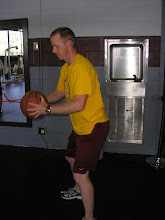
Lately it seems that I have had several hip/back issues to deal with. And in each case teh remedy has been a functional hips stretch.
Have the individual stand on the effected leg and with the other foot have them perform a toe tap in the transverse plane allowing the hip to "open and close". Think of them standing on the fact of a clock with there right leg let's say. The right foot will be placed with the toes facing 12. With the other leg they will see how far they can reach, for example, can they reach from 2 and then pivot backwards and toe touch the 6? Do not hold at either position for any length of time. This is a very effective way to lengthen the external rotators (ERs) and teh internal rotaors (IRs) of the hips while weightbearing and against gravity.
Try it and see what you think.
Showing posts with label pain. Show all posts
Showing posts with label pain. Show all posts
Friday, April 16, 2010


Wednesday, March 18, 2009
Pitching and external rotation.
The smell of freshly cut canvas of green, dew from the grass wetting your cleats, leather and the crack of the bat. It's that time again, Baseball season. Still we see conditioning programs focusing on the external rotators (ER) of the shoudler (supraspinatus, infraspinatus, teres minor). If you've been in baseball long enough you realize that the ERs of the shoulder do not perform external rotation of the humerus while in the acceleration phase of the pitching motion. The importance of the ERs come into play in deceleration but only a fraction of the percentage. The majority of the deceleration comes form the opposite low back, hip and leg. See Serape Effect.
There is little need to train the ERs to concentrically contract. The emphasis should be on teaching the entire body to share the responsibility of deceleration in order to protect the shoulder.
There is little need to train the ERs to concentrically contract. The emphasis should be on teaching the entire body to share the responsibility of deceleration in order to protect the shoulder.
Wednesday, March 11, 2009
The Spine
Once again I am thinking of a statement said by Dr. Stuart McGill. He gave the anaogy that the spine is like a clothes hanger and will has a breaking point when bent too many times. However there are a decent number of people who never have to see a Dr. for their back because they don't have back problems. My own father for example is 76 years old and I asked him if he ever had back problems. His answer was "No". He worked in manual labor for the majority of his life and before that was a 3 sport athlete. We always focus on the 80-90 % who have back pain but why don't we ask the question, "Why do the 10-20% NOT have back pain?"
The second question I would like to ask is, "Why that particular vertebrae?" Why not another one? If we can find the answer to "Why this one?" I think we may be able to fix more than just the symptoms.
For a great perspective on this go to the Gray Institute's website and read this months newsletter on knees.
The second question I would like to ask is, "Why that particular vertebrae?" Why not another one? If we can find the answer to "Why this one?" I think we may be able to fix more than just the symptoms.
For a great perspective on this go to the Gray Institute's website and read this months newsletter on knees.
Subscribe to:
Posts (Atom)